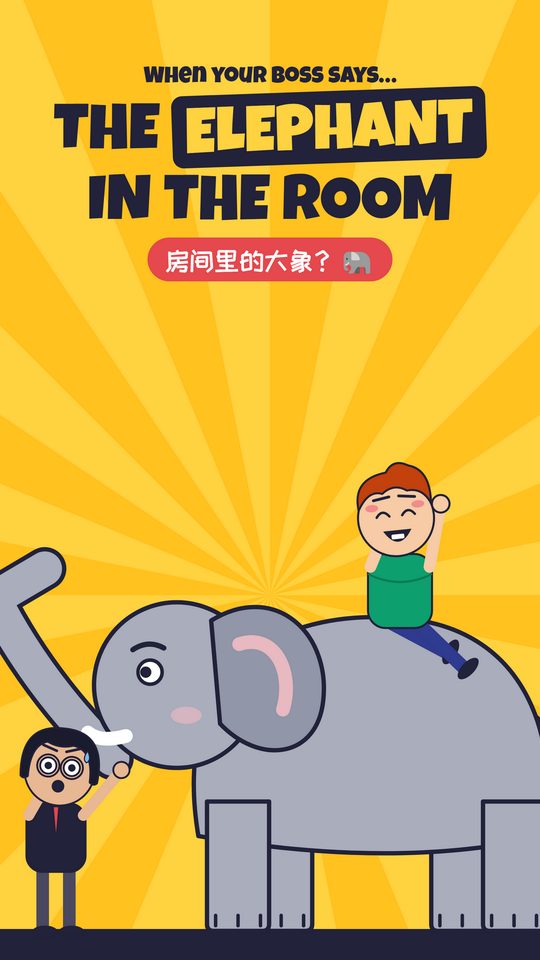
the elephant in the room
/ði ˈelɪfənt ɪn ðə ruːm/
a big, obvious problem that everyone avoids talking about
In the video
The boss says the budget is gone and they can’t ignore the elephant in the room. Peter thinks there is a real elephant, so he goes to find one and leads it into the office. The boss is shocked, and then the elephant soaks her with its trunk.
What it really means
Imagine an elephant standing in a room. Everyone can see it, but they all pretend it isn’t there. “The elephant in the room” is a problem like that: big and obvious, but nobody wants to be the first to mention it.
The image is often linked to a fable by the Russian writer Krylov, about a man at a museum who notices all the small things but misses the elephant. Today the phrase simply means a problem people are avoiding.
When to use it
Use it in a meeting or a family talk when there is an awkward but important topic nobody has mentioned, such as money problems, job cuts or a relationship. The tone is serious. Common patterns are “address the elephant in the room” and “talk about the elephant in the room”.
Examples
- Let’s talk about the elephant in the room.
- Nobody mentioned the budget, but it was the elephant in the room.
- I’d like to address the elephant in the room before we start.
Common mistake
✗ Let’s talk about the elephant of the room.
✓ Let’s talk about the elephant in the room.
The preposition is “in”, not “of”. This is a fixed phrase, so you can’t change it.
Similar phrases
- the awkward truth a fact people don’t want to face; it isn’t always a topic everyone is avoiding
- a taboo subject a topic you should not talk about; a stronger phrase