Learn English phrases with short videos
The boss says a common English phrase. Peter does exactly what the words say, and it always goes wrong. Watch the short, then read the full explanation: the real meaning, where it comes from, when to use it, examples and common mistakes.
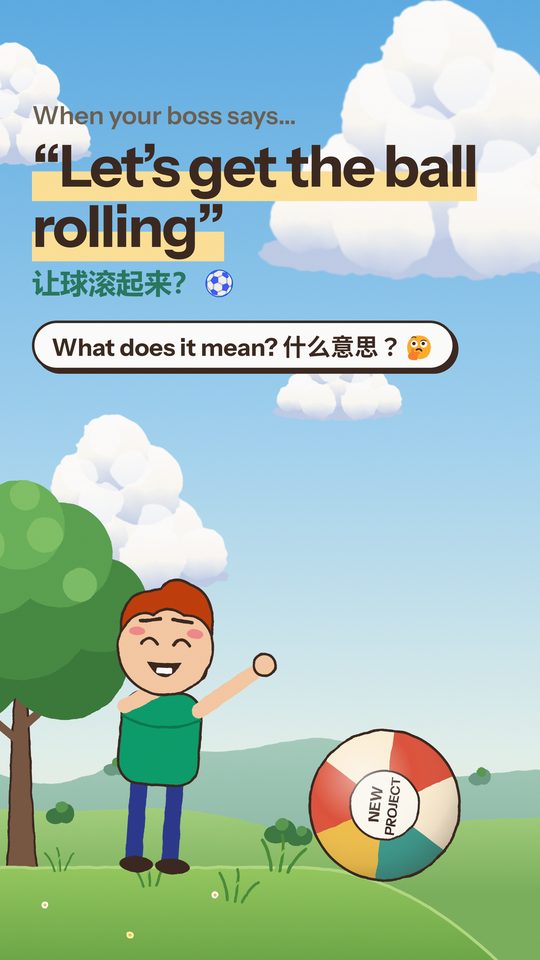
get the ball rolling
/ɡet ðə bɔːl ˈrəʊlɪŋ/
= to start something, often by taking the first step
In the video
The boss says the new project starts today: “Let’s get the ball rolling!” So Peter pushes a giant ball labelled NEW PROJECT down a hill. When she asks where her project is, he points at the tiny ball far away: “Over there, boss! Still rolling!”
What it really means
Think about a heavy ball. The hard part is the first push. Once it moves, it keeps going by itself. Work is the same, so “get the ball rolling” means taking that first step so that things start to happen.
A popular story links the phrase to American elections in the 1800s, when supporters pushed huge balls through the streets. Today it has nothing to do with balls.
When to use it
Use it in meetings, at the start of a project, or when everyone is waiting for someone to begin. It sounds friendly and positive, and it works with colleagues and managers. To say “keep it going”, use “keep the ball rolling”.
Examples
- Let’s get the ball rolling on the new project.
- Who wants to get the ball rolling with the first idea?
- I’ll send the first draft today to get the ball rolling.
Common mistake
✗ Let’s roll the ball on this project.
✓ Let’s get the ball rolling on this project.
You can’t change the words in this phrase. “Roll the ball” is only about a ball. To say “start”, use the whole phrase.
Similar phrases
- kick things off to begin something; very common for meetings and events
- get started to begin; the simplest choice, and it works anywhere
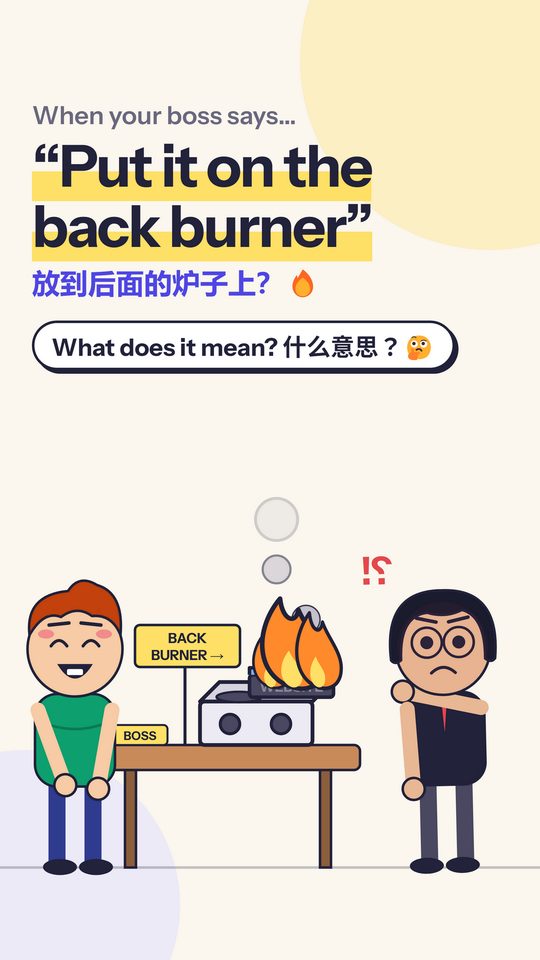
put it on the back burner
/pʊt ɪt ɒn ðə bæk ˈbɜːnə/
= to leave something until later because other things matter more
In the video
The boss says the website can wait: “Put it on the back burner.” Peter puts the WEBSITE folder on the back ring of a stove and turns it on. When she comes back, her project is on fire.
What it really means
A back burner is the ring at the back of a stove. When you cook, the food that needs attention goes at the front. Food that can cook slowly goes at the back.
So when you put something on the back burner, you stop working on it for now and do more important things first. It is not cancelled. It just isn’t the priority.
When to use it
Use it when talking about priorities. The tone is neutral. Something urgent is a “front-burner issue”. If you mean you are giving up on something completely, say “drop it” or “cancel it” instead.
Examples
- Let’s put this idea on the back burner for now.
- The redesign is on the back burner until after the launch.
- I had to put my studies on the back burner while I was working full-time.
Common mistake
✗ We cancelled the plan, so it’s on the back burner.
✓ We’ve put the plan on the back burner until next year.
“On the back burner” doesn’t mean cancelled. It means delayed: the plan still exists, and you will come back to it.
Similar phrases
- put a pin in it to stop discussing something for now; common in meetings
- put on hold to pause something; more formal, often for projects and orders
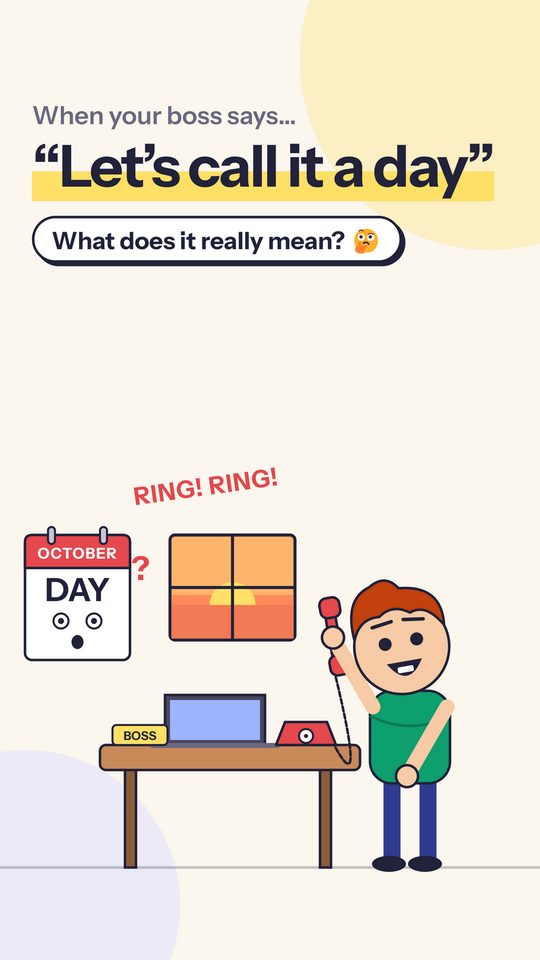
call it a day
/kɔːl ɪt ə deɪ/
= to stop working for the day
In the video
The boss says: “Great work today. Let’s call it a day!” Peter thinks he has to phone someone named Day, so he picks up the phone and keeps ringing. At 9 p.m. he is still waiting for Day to answer.
What it really means
Here “call” doesn’t mean “phone”. It means “name” or “say that something is”. You are saying that what you have done is enough to count as a day’s work.
It is about deciding to stop, so you don’t have to wait for the end of office hours. You can say it after a long morning too.
When to use it
Use it when you stop working, studying or doing a job at home. It sounds relaxed. At night, you can say “call it a night”. It can also mean ending something for good, like retiring or closing a business.
Examples
- It’s 6 p.m. Let’s call it a day.
- We’ve finished the report, so I think we can call it a day.
- After 40 years, the owner decided to call it a day and closed the shop.
Common mistake
✗ It’s 6 p.m. Let’s finish the day.
✓ It’s 6 p.m. Let’s call it a day.
“Finish the day” doesn’t sound natural. When you and your colleagues stop work, say “call it a day”.
Similar phrases
- wrap up to finish a job or a meeting; it doesn’t always mean stopping for the day
- call it a night to stop for the night, after a party or evening work
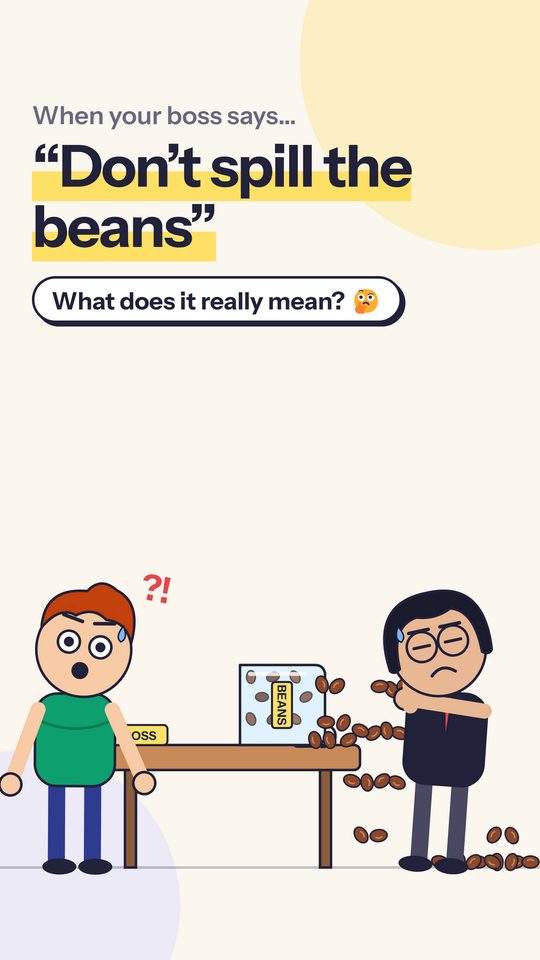
spill the beans
/spɪl ðə biːnz/
= to tell a secret, often too early
In the video
The new office is a surprise, so the boss tells Peter: “Don’t spill the beans!” He carefully carries a big jar of beans around, while the whole team finds out about the office anyway. Peter is proud: “I didn’t spill a single bean!”
What it really means
If you knock over a jar of beans, they go everywhere and you can’t easily get them back. A secret is the same: once you tell it, you can’t take it back.
Some people say the phrase comes from voting with beans in ancient Greece, but there is no real proof of this. Just remember that it means telling a secret.
When to use it
Use it for surprises, news that isn’t public yet and gossip. It is casual and mostly spoken. In formal writing, use “disclose” or “reveal”.
Examples
- Who spilled the beans about the party?
- Don’t spill the beans! It’s a surprise.
- He finally spilled the beans about his new job.
Common mistake
✗ Don’t spill the bean.
✓ Don’t spill the beans.
“Beans” is always plural. This is a fixed phrase, so you can’t change it to “bean”.
Similar phrases
- let the cat out of the bag to tell a secret by accident, often a surprise
- give the game away to reveal a plan or the truth without meaning to
under the weather
/ˈʌndə ðə ˈweðə/
= feeling a little sick
In the video
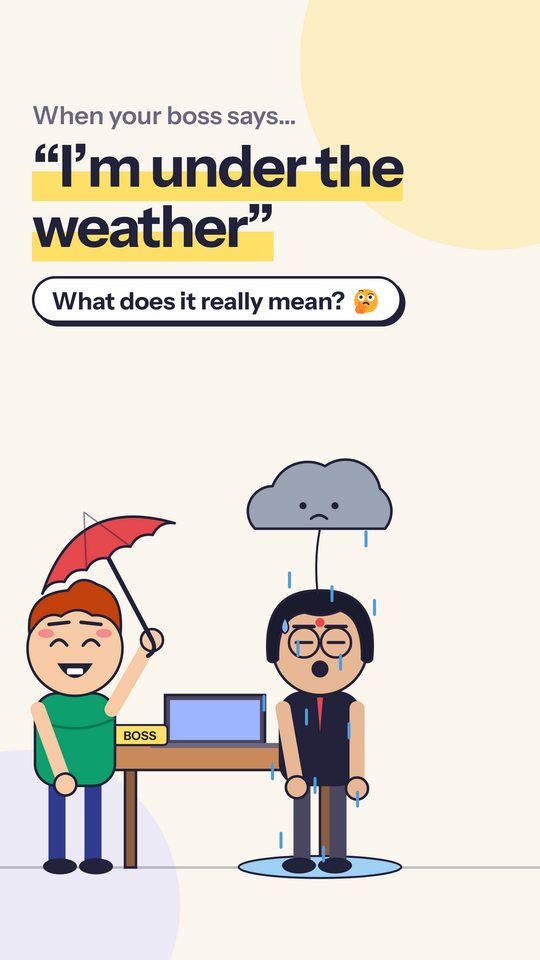
The boss says: “I’m feeling a bit under the weather.” Peter brings a rain cloud and puts it over her head: “Now you’re officially UNDER the weather!” She sneezes and explains that it means she is sick.
What it really means
“Under the weather” has nothing to do with the weather. It means you feel a little unwell, like when you have a light cold, a headache or you are very tired.
A popular story says it comes from sailing: sailors who felt seasick went below deck, away from the storm. Today it just means “not feeling well”.
When to use it
Use it when you take a sick day or explain why you are not at your best. It is a polite way to say you are sick without giving details. Use it only for small problems, not for serious illness.
Examples
- I’m a bit under the weather, so I’ll work from home today.
- You look under the weather. Do you need a break?
- She’s been under the weather all week.
Common mistake
✗ I’m under the weather because it’s raining.
✓ I’m a bit under the weather, so I’ll work from home today.
The phrase has nothing to do with rain. It only means you feel a little sick.
Similar phrases
- feeling off not feeling quite right, in your body or your mood; more casual
- coming down with something starting to get sick; the first signs are there
break the ice
/breɪk ðə aɪs/
= to help people relax and start talking when they don’t know each other
In the video
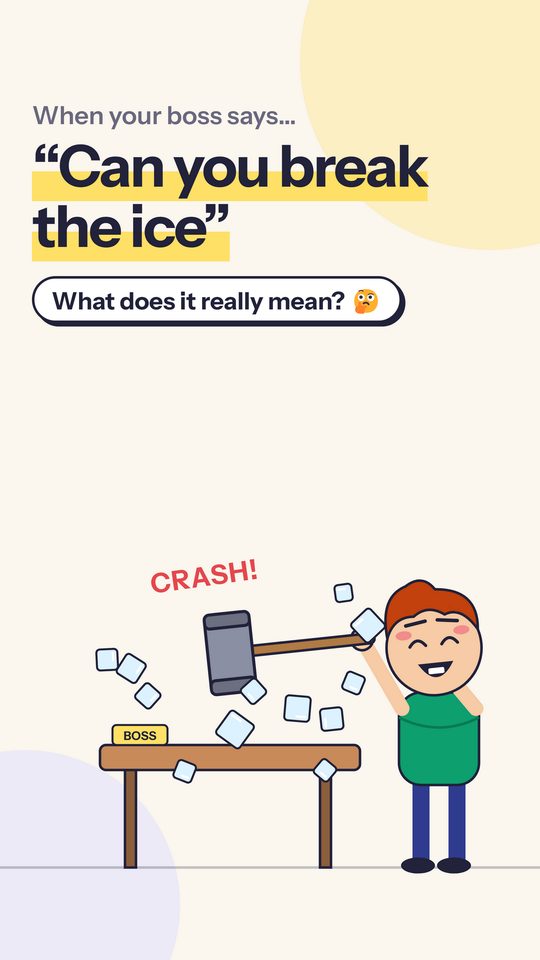
New clients arrive, and the boss asks Peter: “Can you break the ice?” He drags in a giant mallet and smashes a block of ice, sending cubes everywhere. She has to explain that she wanted him to help the clients relax and start talking.
What it really means
When people first meet, the room can feel frozen: nobody knows what to say. To break the ice is to end that awkward feeling.
The image probably comes from icebreaker ships, which smash the ice so that other ships can pass. A first friendly comment does the same job: after it, talking is easier.
When to use it
Use it for the start of a meeting, meeting new people, team events or dates. A related word is “icebreaker”, an activity such as a short game before a meeting.
Examples
- Let’s break the ice with a quick game before the meeting.
- He told a funny story to break the ice.
- A simple “Where are you from?” can break the ice.
Common mistake
✗ She told a joke to break the silence ice.
✓ She told a joke to break the ice.
This is a fixed phrase, so don’t add extra words. “Break the silence” is a different phrase, so don’t mix them.
Similar phrases
- warm up the room to make an audience feel relaxed; used for talks and events
- start the conversation to begin talking; the simple way to say it, with no image
put a pin in it
/pʊt ə pɪn ɪn ɪt/
= to stop talking about something for now and come back to it later
In the video
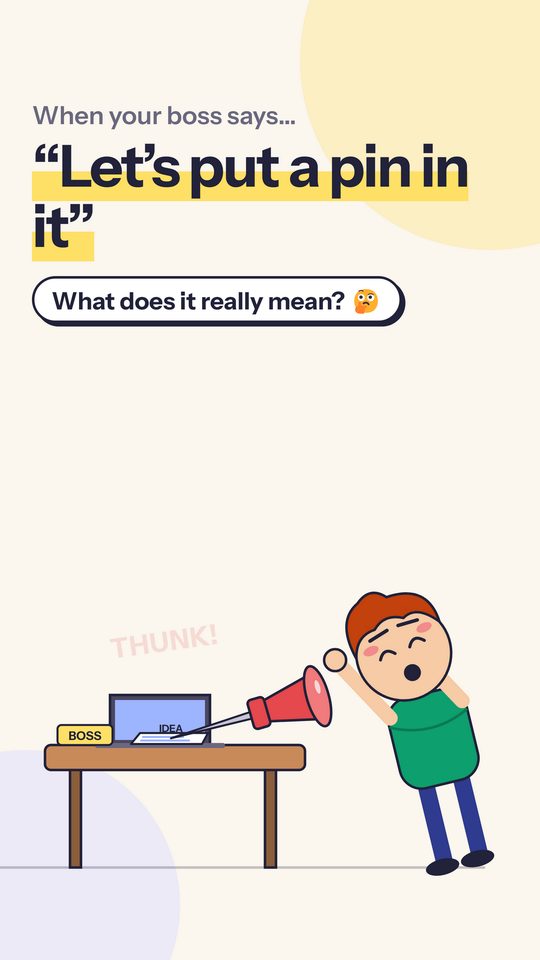
The boss says Peter’s idea is good, but “let’s put a pin in it for now”. Peter gets a giant pin and stabs it right through the report: “Your idea is pinned. It’s not going anywhere.”
What it really means
Imagine pinning a note to a noticeboard. You aren’t dealing with it now, but it stays there, so you will see it and remember it later.
So the phrase says that the topic is worth discussing, just not right now. It is much more polite than saying “let’s not talk about that”.
When to use it
It is most common in meetings, when someone goes off topic or time is short. You can add a time: “put a pin in it until next week”. To return to the topic, say “Let’s come back to the idea we pinned.”
Examples
- Good point, but let’s put a pin in it until next week.
- We’re short of time, so I’ll put a pin in that.
- Can we put a pin in it and come back after lunch?
Common mistake
✗ Let’s put a pin on it.
✓ Let’s put a pin in it.
The preposition is “in”, not “on”. This is a fixed phrase, and “on” sounds wrong.
Similar phrases
- come back to it later to return to a topic later; clear and fine anywhere
- table it to delay a discussion. Be careful: in American English it means delay, but in British English it means start discussing
think outside the box
/θɪŋk ˌaʊtˈsaɪd ðə bɒks/
= to think of new, creative ideas, not the usual ones
In the video
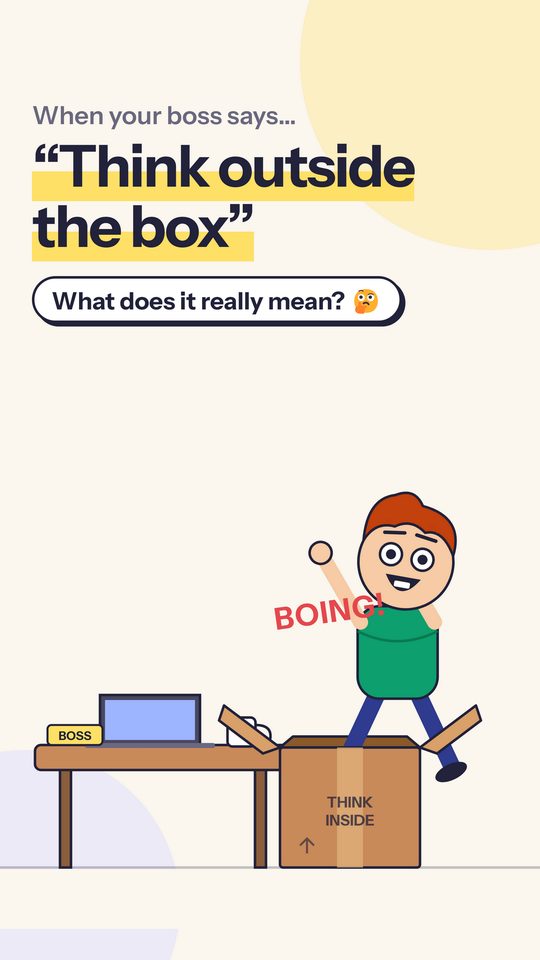
The boss needs fresh ideas: “Think outside the box!” Peter climbs into a big cardboard box, bursts out and proudly says he is officially outside the box. Then he asks if he should get back in.
What it really means
The “box” here means your usual way of thinking. To think outside it means not following those limits and looking at a problem in a new way.
The phrase is often linked to a famous nine-dot puzzle. To join all the dots with four straight lines, you have to draw past the edge of the square.
When to use it
Use it in brainstorming or when you need a new approach. It is positive, but many people have heard it too often. In formal writing or a job application, “creative” or “innovative” is better.
Examples
- We need to think outside the box to win this client.
- Her ideas are great because she thinks outside the box.
- Let’s think outside the box and try something new this year.
Common mistake
✗ We need to think out of box.
✓ We need to think outside the box.
You need “the”. Some British speakers say “think out of the box”, but “the” stays there too.
Similar phrases
- think creatively to use new ideas; direct, with no image, and more formal
- think differently to look at something in a new way; simple and fine anywhere
take it offline
/teɪk ɪt ˌɒfˈlaɪn/
= to talk about something later, outside the meeting, with only the people who need to be there
In the video
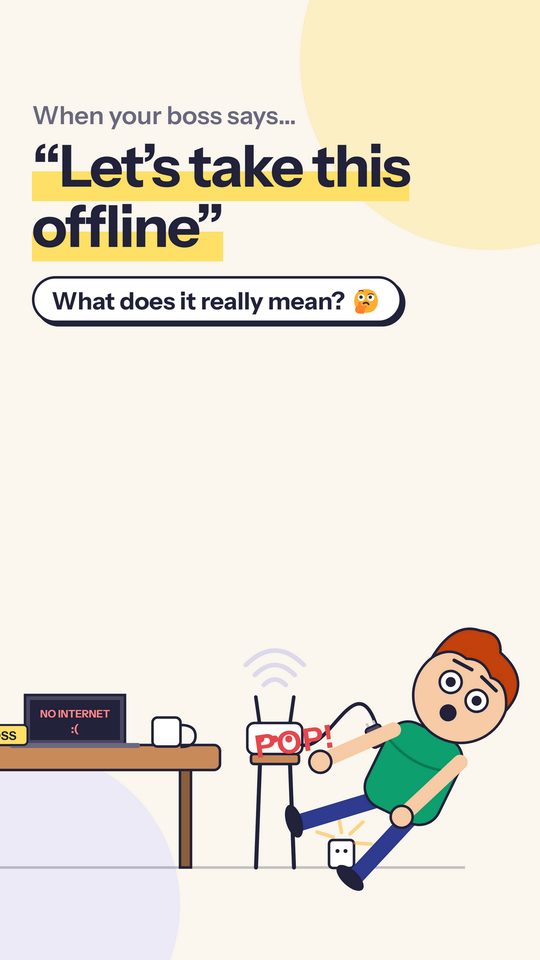
The meeting is out of time, and the boss says: “Let’s take this offline.” Peter pulls the plug on the router, and the whole office loses the internet. She explains that she only meant they should talk about it later.
What it really means
“Offline” usually means “not connected to the internet”. In a meeting, though, being “online” means being in the main discussion. So taking something offline means moving it out of the meeting, to talk about it with the right people.
It doesn’t mean “let’s not talk about it”. It means “this isn’t the right place”, usually because the topic is too detailed, only matters to a few people, or there isn’t enough time.
When to use it
It is most common when a meeting gets too detailed or two people start to argue. The person leading can say “Let’s take this offline after the call.” The meeting moves on, and nobody feels ignored.
Examples
- Good point. Let’s take this offline after the call.
- This is getting detailed, so let’s take it offline.
- Can we take that offline? It only affects our team.
Common mistake
✗ Please take this offline. I don’t want to discuss it again.
✓ Let’s take this offline and discuss it after the meeting.
It isn’t a way to refuse to talk. It means talking at another time, with the right people.
Similar phrases
- discuss it separately to talk about something in a separate discussion; clear and a little formal, good for email
- talk about it after the meeting the simplest way to say it, with no office jargon
DictionifyChrome extension
Found an English word you don’t know?
Double-click any word on any website. Dictionify reads the whole sentence and explains what the word means in that sentence, in plain English, with pronunciation and examples. Go Pro for unlimited lookups and translations, plus Summary and Polish.
Add to Chrome- Pro: unlimited lookups
- Summary and Polish
- 7-day Pro trial