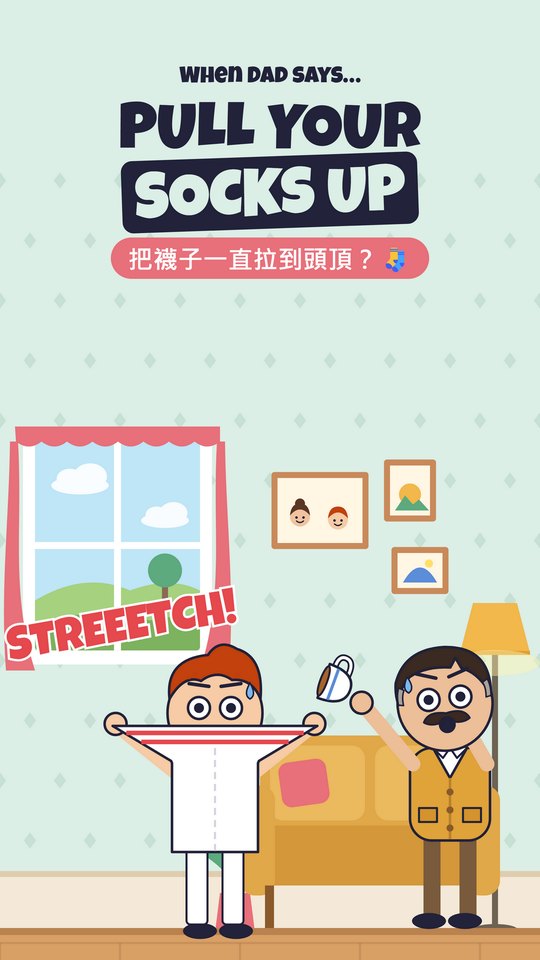
pull your socks up
/pʊl jɔː sɒks ʌp/
to make an effort to improve, because you have not been doing well
In the video
Peter’s report card has a big red F. Dad waves it and says, “Look at these grades! Pull your socks up, Peter!” Peter takes it literally: he yanks his socks up past his knees, past his tummy and right over his head, YANK! STREEETCH!, and says, “Dad! My socks are all the way up!” Unable to see, he waddles into Dad and flips Dad’s teacup onto his head. Dad shouts, “Peter! My tea! Take those off!”
What it really means
Literally, “pull your socks up” means to pull up socks that have slipped down.
It really means to try harder and improve. Picture someone tidying themselves up and getting ready to work properly. It is common in British English, usually said by a teacher, parent or boss to someone who is not doing well enough.
When to use it
Use it to tell someone to work harder because their results are not good enough. Common patterns are “You need to pull your socks up” and “He pulled his socks up and passed”. It sounds a little like a telling-off.
Examples
- You need to pull your socks up this term.
- Pull your socks up, or you’ll fail the exam!
- He pulled his socks up and passed at last.
Common mistake
✗ It is cold today, so pull your socks up and work harder.
✓ Your marks are falling. You need to pull your socks up.
“Pull your socks up” is about effort, not about socks.
Similar phrases
- try harder the plain way to say it, with no telling-off
- buck up British and informal: to cheer up, or to improve
More like this: 💪 Encouragement and feelings11 phrases