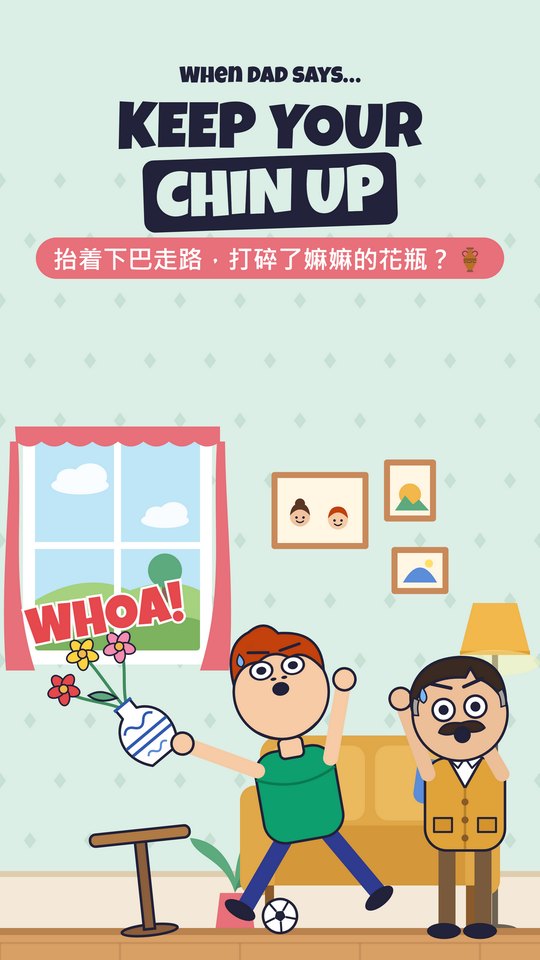
keep your chin up
/kiːp jɔː tʃɪn ʌp/
to stay hopeful and brave when things are difficult or disappointing
In the video
Peter lost his football match and feels glum. Dad says, “You lost the match? Keep your chin up, Peter!” Peter takes it literally: he walks around with his chin pointing at the ceiling and says, “Look, Dad! My chin is up all day!” He cannot see where he is going, trips on his football, WHOA!, bumps the side table, and Grandma’s vase smashes, CRASH! Dad shouts, “Peter! You broke Grandma’s vase!”
What it really means
Literally, “keep your chin up” means to hold your chin high in the air.
People look down when they are sad, and lift their heads when they feel confident. So the phrase means “stay positive, don’t lose heart”. It is often shortened to “Chin up!”
When to use it
Say it to cheer up a friend who has lost a game, failed a test or had bad news. Common patterns are “Keep your chin up!” and “Chin up! Things will get better”. It is warm and friendly.
Examples
- You lost today, but keep your chin up!
- Keep your chin up! Next time will be better.
- Chin up! Tomorrow is a new day.
Common mistake
✗ Keep your chin up when the dentist checks your teeth.
✓ You lost today, but keep your chin up!
“Keep your chin up” is encouragement; it is not about where your chin is.
Similar phrases
- hang in there also encouragement: keep going, do not give up
- cheer up a more direct way to tell someone not to be sad
More like this: 🦵 Body idioms8 phrases💪 Encouragement and feelings11 phrases